
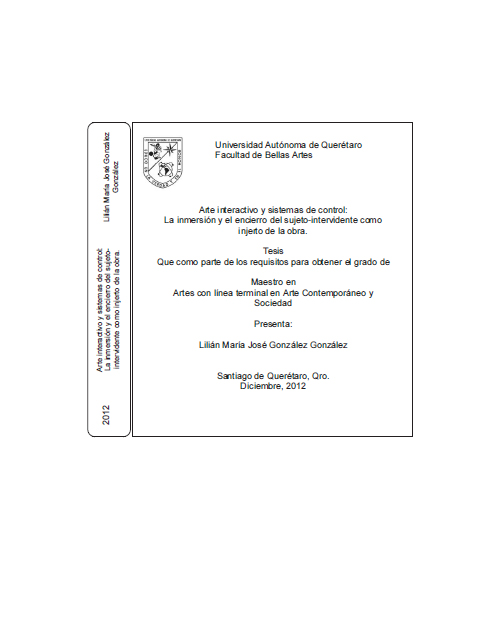
Arte interactivo y sistemas de control: La inmersión y el encierro del sujeto intervidente como injerto de la obra.
Dublin Core
Título
Arte interactivo y sistemas de control: La inmersión y el encierro del sujeto intervidente como injerto de la obra.
Autor
Lilián María José González González
Mediador
Dra. María Margarita De Haene Rosique
Procedencia
Facultad de Bellas Artes/Maestría en Artes con línea terminal en Arte Contemporáneo y Sociedad
Resumen
Las obras de arte que utilizan nuevas tecnologías generan una relación
interesante entre el sujeto y el objeto artístico que en casos específicos apuntan a
la representación o alusión de los sistemas de control social. Después de la
revisión de varios textos sobre arte digital, Realidad Virtual y arte interactivo, se
encontró la falta de conceptualización y reflexión teórica en torno a las obras
artísticas que representan de forma explícita o disfrazada los sistemas de control
existentes dentro del arte interactivo y la Realidad Virtual. Es por esto que será
enriquecedor proponer nuevos enfoques interpretativos a estas obras de arte,
encontrando en ellas las estrategias operativas de los sistemas de control y
encierro hacia el sujeto mediante tres enfoques principalmente; el primero
mediante la abolición de la distancia entre el sujeto y la obra, es decir el sujeto
queda sumergido –encerrado- dentro de la obra, el segundo es la noción de sujeto
como injerto de la obra dejando de ser solamente el espectador y ahora
disolviéndose en la obra hasta convertirse en injerto y finalmente el tercero es la
representación de una obra que encarcela, encierra, utiliza, manipula y vigila al
espectador representando de esta manera explícitamente los sistemas de control
social. Con estas tres vertientes este texto genera una nueva categoría de análisis
del arte y el uso de nuevas tecnologías que puede resultar enriquecedor para
estudios de arte digital, Realidad Virtual y Arte Interactivo.
interesante entre el sujeto y el objeto artístico que en casos específicos apuntan a
la representación o alusión de los sistemas de control social. Después de la
revisión de varios textos sobre arte digital, Realidad Virtual y arte interactivo, se
encontró la falta de conceptualización y reflexión teórica en torno a las obras
artísticas que representan de forma explícita o disfrazada los sistemas de control
existentes dentro del arte interactivo y la Realidad Virtual. Es por esto que será
enriquecedor proponer nuevos enfoques interpretativos a estas obras de arte,
encontrando en ellas las estrategias operativas de los sistemas de control y
encierro hacia el sujeto mediante tres enfoques principalmente; el primero
mediante la abolición de la distancia entre el sujeto y la obra, es decir el sujeto
queda sumergido –encerrado- dentro de la obra, el segundo es la noción de sujeto
como injerto de la obra dejando de ser solamente el espectador y ahora
disolviéndose en la obra hasta convertirse en injerto y finalmente el tercero es la
representación de una obra que encarcela, encierra, utiliza, manipula y vigila al
espectador representando de esta manera explícitamente los sistemas de control
social. Con estas tres vertientes este texto genera una nueva categoría de análisis
del arte y el uso de nuevas tecnologías que puede resultar enriquecedor para
estudios de arte digital, Realidad Virtual y Arte Interactivo.
Descripción
Works of art using new technologies create an interesting relationship
between the subject and the artistic object, which in specific cases points to the
representation or allusion of social control systems. After reviewing of several texts
on Digital Art, Virtual Reality and Interactive Art, a lack of conceptualization and
theoretical reflection regarding the artistic works that represent explicitly or in a
disguised manner the control systems that exist within Interactive Art and Virtual
Reality was found. As a result, it will be enriching to propose new interpretive
focuses on these art works, finding in them the operative strategies of the system
of control and enclosure of the subject chiefly through three focuses: the first
through the abolition of distance between the subject and the work, in other works,
the subject is immersed closed within the work; the second is notion of the subject
as an implant within the work, ceasing to be only a viewer and becoming dissolved
in the work until he/she becomes and implant; finally, the third is the representation
of a work that imprisons, closes in, utilizes, manipulates and keeps guard over the
viewer, thus explicitly representing the system of social control. By using these
three aspects, this text creates a new category of art analysis and the use of new
technologies that can be enriching for Digital Art, Virtual Reality and Interactive Art
studies.
between the subject and the artistic object, which in specific cases points to the
representation or allusion of social control systems. After reviewing of several texts
on Digital Art, Virtual Reality and Interactive Art, a lack of conceptualization and
theoretical reflection regarding the artistic works that represent explicitly or in a
disguised manner the control systems that exist within Interactive Art and Virtual
Reality was found. As a result, it will be enriching to propose new interpretive
focuses on these art works, finding in them the operative strategies of the system
of control and enclosure of the subject chiefly through three focuses: the first
through the abolition of distance between the subject and the work, in other works,
the subject is immersed closed within the work; the second is notion of the subject
as an implant within the work, ceasing to be only a viewer and becoming dissolved
in the work until he/she becomes and implant; finally, the third is the representation
of a work that imprisons, closes in, utilizes, manipulates and keeps guard over the
viewer, thus explicitly representing the system of social control. By using these
three aspects, this text creates a new category of art analysis and the use of new
technologies that can be enriching for Digital Art, Virtual Reality and Interactive Art
studies.
Fecha de creación
2012
Identificador
ReDCAAcademico000046
Sumario
Académico/ReDCA/Facultad de Bellas Artes
Propietarios de los derechos
Académico, ReDCA, FBA, UAQ
Licencia
Creative Commons: Attribution-NonCommercial-NoDerivatives 4.0 International (CC BY-NC-ND 4.0) (https://creativecommons.org/licenses/by-nc-nd/4.0/)
Other Media
Citación
Lilián María José González González, “Arte interactivo y sistemas de control: La inmersión y el encierro del sujeto intervidente como injerto de la obra.,” ReDCA-Académico, consulta 3 de junio de 2026, http://redca.uaq.mx/academico/items/show/20.
Documentos relacionados
Este objeto no tiene relaciones.