
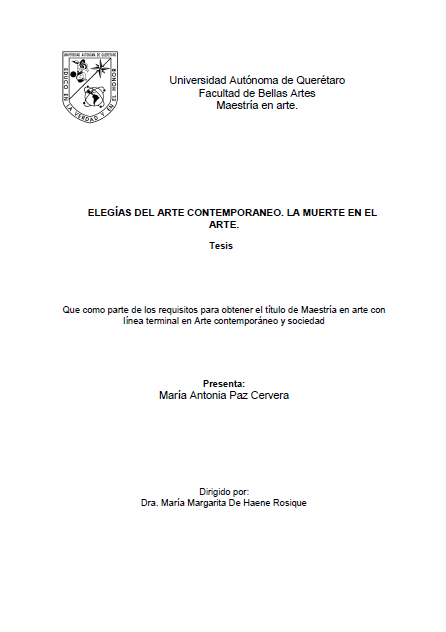
Elegías del arte contemporáneo. La muerte en el arte.
Dublin Core
Título
Elegías del arte contemporáneo. La muerte en el arte.
Autor
María Antonia Paz Cervera
Mediador
Dra. María Margarita De Haene Rosique
Procedencia
Facultad de Bellas Artes/Maestría en Arte con línea terminal en Arte contemporáneo y sociedad
Resumen
La muerte, y la conciencia de la muerte, han sido acompañantes perennes de la humanidad. Las actitudes hacia este hecho ineludible de nuestra existencia se han modificado, cada vez con más premura, a través de la historia de las ideas. Desde el intercambio simbólico entre la vida y la muerte en las sociedades tradicionales, pasando por la convivencia festiva con los muertos, el culto a los ancestros y el lamento romántico, se ha llegado finalmente a la negación contemporánea de la muerte. En el arte contemporáneo pueden observarse críticas y respuestas a la actual negación de la muerte. Las nuevas formas del lamento buscan regresar a la muerte de su exilio y confrontar a la sociedad con esa angustia muda en la que se ha convertido. Las elegías del arte contemporáneo son elegías a la muerte. Profundamente marcados por la historia, los tres artistas elegidos para analizar el fenómeno de la elegía en el arte contemporáneo emanan de contextos en los que la muerte, masiva y violenta, ha vuelto imposible su negación: Shimon Attie y Christian Boltansky en relación al Holocausto, Teresa Margolles en medio de las decenas de miles de víctimas de la violencia en los inicios de este siglo en México. ¿Qué actitud hacia la muerte une a estos tres artistas? ¿Qué reflexión sobre nuestra negación contemporánea de la muerte arrojan sobre los espectadores? Nos encontramos aquí con una nueva forma del lamento. El objeto principal de lo lamentado no es, aquí, un ser amado, se está llorando la ausencia de la muerte.
Descripción
Death, and consciousness of death, have been with humanity accompanied from its origins. The attitudes towards this unavoidable aspect of our existence have changed, more rapidly now than ever, throughout the history of ideas. With these ideas ranging from the symbolic interchange between life and death in traditional societies, passing through the festive coexistence with the dead, to the cult to ancestors and the romantic elegy, we have finally come to contemporary denial of death. In contemporary art we can observe critics of and answers to the present denial of death. New forms of lament seek to bring death back from its exile and confront society with this mute anguish, which it has turned into. The elegies of contemporary art are elegies to death. Deeply marked by history, the three artists I have chosen to analyze concerning the phenomenon of the elegy in contemporary art, come from contexts in which death wide spread, massive and violent, has made its denial impossible: Shimon Attie and Christian Boltansky in relation to the Holocaust, and Teresa Margolles in the midst of thousands of dead from the violence that erupted in the first decades of this century in Mexico. What is the attitude towards death that links these three artists? How can their reflections enlighten us in the face of contemporary denial of death? We can find here a new form of lament. The main object of loss here is not the beloved; it’s the absence of death, which is being lamented here.
Fecha de creación
2014
Identificador
ReDCAAcademico000029
Sumario
Académico/ReDCA/Facultad de Bellas Artes
Propietarios de los derechos
Académico, ReDCA, FBA, UAQ
Licencia
Creative Commons: Attribution-NonCommercial-NoDerivatives 4.0 International (CC BY-NC-ND 4.0) (https://creativecommons.org/licenses/by-nc-nd/4.0/)
Other Media
Citación
María Antonia Paz Cervera, “Elegías del arte contemporáneo. La muerte en el arte.,” ReDCA-Académico, consulta 3 de junio de 2026, http://redca.uaq.mx/academico/items/show/41.
Documentos relacionados
Este objeto no tiene relaciones.