
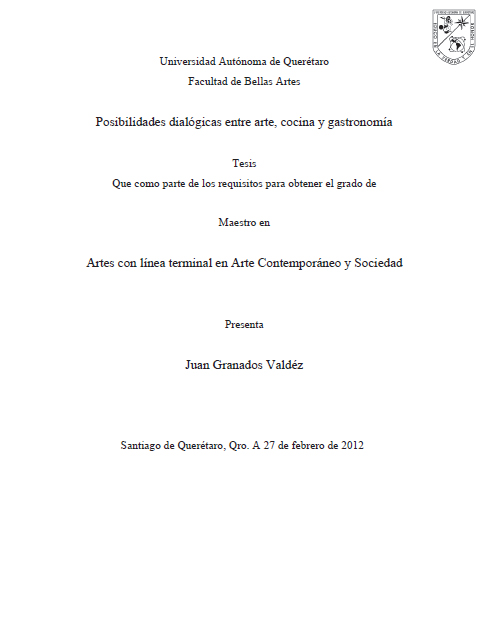
Posibilidades dialógicas entre arte, cocina y gastronomía.
Dublin Core
Título
Posibilidades dialógicas entre arte, cocina y gastronomía.
Autor
Juan Granados Valdéz
Mediador
M. en A. José Antonio Arvizu Valencia
Procedencia
Facultad de Bellas Artes/Maestría en Artes con línea terminal en Arte Contemporáneo y Sociedad
Resumen
El interés suscitado recientemente por cuestiones de alimentación declara que no es posible mantenerse al margen de cosa tan acuciante como lo es el comer, pues no es sino comiendo que se vive, y no es sino viviendo que se hace arte y cultura. Al volver la vista a la historia del arte, la cocina y la gastronomía se descubre no sólo que la historia de las tres disciplinas es emocionante, sino que desde antiguo han guardado relaciones abundantes. En las pinturas rupestres su sentido religioso se conjuga con el artístico y gastronómico. Las naturalezas muertas o los bodegones, avant la lettre, de Egipto, Grecia y Roma, además del llamamiento espiritual que hacen a sus espectadores, recuerdan los usos y costumbres alimentarios de dichos pueblos. La vida de las ciudades holandesas quedó retratada en naturalezas muertas de mercados y carnicerías. Éstas no sólo educaron en el humanismo,enseñaron, también, a servir la mesa. La palabra utilizada en español para nombrar estos cuadros, bodegón, recuerda la bodega o despensa, lugar de acopio de los alimentos. Dos casos extraordinarios son el de Leonardo da Vinci y el de Gioacchino Rossini, ambos artistas y ambos interesados por la cocina. El siglo XX está lleno de artistas que usan la cocina y la comida para hacer arte: Daniel Spoerri, Alison Knowles, Martha Minujín y Rirkrit Tiravanija. La propuesta de esta tesis es teórica y documental. El asunto es las posibles alianzas, dialógicas se sugiere, entre el arte, la cocina y la gastronomía. Se sostiene que la cocina y la gastronomía no son arte, pero sí se relacionan y entablan un diálogo. No se plantea el caso de que se trate sólo de disciplinas distintas, sino que se influyen. Esta influencia ya fue documentada críticamente, con sus dificultades, por Alfonso Reyes, por mencionar un caso.
Descripción
The interest aroused by issues of food recently stated that it is not possible to stay out of something as compelling as it is eating, but eating is how you live, but living is how to make art and culture. Looking back at the history of art, cuisine and
gastronomy is found not only the stories of the three disciplines are exciting, but from old relationships have saved abundant. In the cave paintings religious sense combined with the artistic and gastronomic. The still lifes, avant la lettre, Egypt, Greece and Rome, as well as spiritual appeal to your viewers do recall eating habits and customs of these peoples. The city life was portrayed in Dutch still lifes of markets and butchers. They not only educated on humanism, taught also to serve the table. The Spanish word used to name these paintings, still life, remember the cellar or pantry, instead of gathering food. Two special cases are that of Leonardo da Vinci and Gioacchino Rossini, both artists and both interested in the kitchen. The twentieth century is full of artists who use the kitchen and food to make art: Daniel Spoerri, Alison Knowles, Martha Minujín and Rirkrit Tiravanija. The proposal of this thesis is theoretical and documentary. The issue is the possible alliances, dialogical suggested, between art, cuisine and gastronomy. I argue that the cuisine and gastronomy are not art, but interact and engage in dialogue. It raises the question if only from different disciplines, but influence. This influence was documented and critically, with its difficulties, by Alfonso Reyes, to name a case.
gastronomy is found not only the stories of the three disciplines are exciting, but from old relationships have saved abundant. In the cave paintings religious sense combined with the artistic and gastronomic. The still lifes, avant la lettre, Egypt, Greece and Rome, as well as spiritual appeal to your viewers do recall eating habits and customs of these peoples. The city life was portrayed in Dutch still lifes of markets and butchers. They not only educated on humanism, taught also to serve the table. The Spanish word used to name these paintings, still life, remember the cellar or pantry, instead of gathering food. Two special cases are that of Leonardo da Vinci and Gioacchino Rossini, both artists and both interested in the kitchen. The twentieth century is full of artists who use the kitchen and food to make art: Daniel Spoerri, Alison Knowles, Martha Minujín and Rirkrit Tiravanija. The proposal of this thesis is theoretical and documentary. The issue is the possible alliances, dialogical suggested, between art, cuisine and gastronomy. I argue that the cuisine and gastronomy are not art, but interact and engage in dialogue. It raises the question if only from different disciplines, but influence. This influence was documented and critically, with its difficulties, by Alfonso Reyes, to name a case.
Fecha de creación
2012
Identificador
ReDCAAcademico000056
Sumario
Académico/ReDCA/Facultad de Bellas Artes
Propietarios de los derechos
Académico, ReDCA, FBA, UAQ
Licencia
Creative Commons: Attribution-NonCommercial-NoDerivatives 4.0 International (CC BY-NC-ND 4.0) (https://creativecommons.org/licenses/by-nc-nd/4.0/)
Other Media
Citación
Juan Granados Valdéz, “Posibilidades dialógicas entre arte, cocina y gastronomía.,” ReDCA-Académico, consulta 3 de junio de 2026, http://redca.uaq.mx/academico/items/show/38.
Documentos relacionados
Este objeto no tiene relaciones.