
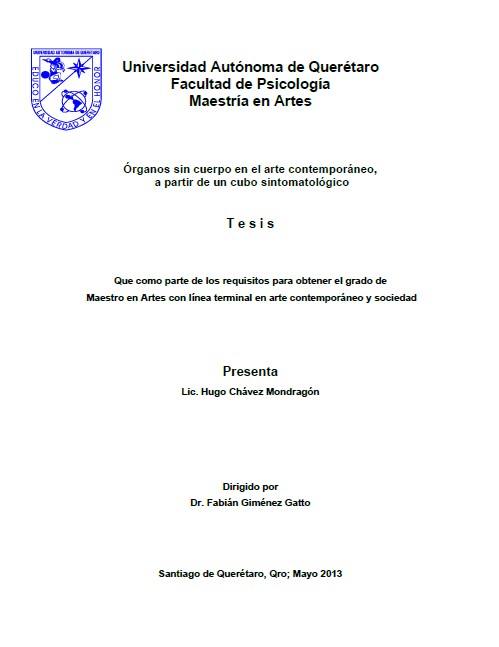
Órganos sin cuerpo en el arte contemporáneo, a partir de un cubo sintomatológico.
Dublin Core
Título
Órganos sin cuerpo en el arte contemporáneo, a partir de un cubo sintomatológico.
Autor
Hugo Chávez Mondragón
Mediador
Dr. Fabián Giménez Gatto
Procedencia
Facultad de Bellas Artes/Maestría en Arte Contemporáneo y Sociedad
Resumen
De Samuel Beckett a Stephen King, de Robert Louis Stevenson a Stanley Kubrick, de William Burroughs a Julio Cortázar, de Los Simpsons a Body parts. Líneas de continuidad, diálogos y testificaciones sobre el problema de sí mismo como otro donde los horizontes de mutación se mezclan para dar un catálogo de figuras desde la pura extrañeza hasta el plan de inmanencia. El miedo de Descartes a la Quimera como una imposibilidad de establecer el "pienso luego existo" se actualiza en producciones literarias y cinematográficas, como si la figura de Legión dentro del Salmo a San Marcos funcionaria no sólo como un espejo de la intertextualidad para Roland Barthes, sino también como un gesto que desemboca en diversos cuadros sintomatológicos para dar cuenta de los problemas del yo con el cuerpo. En palabras del Chuck Palahniuk, el Club de la pelea tiene un gran éxito porque habla de gente que se reúne y ello es un deseo actual. El problema es que en ocasiones aquel con el cual uno mejor se entiende o establece lazo no está en el exterior, sino que constituye un pliegue y se desarrolla no sin dolor, no sin angustia, pero eso sí, bajo el imperativo de una actualización de la alegría, de una ética como estética de sí mismo que la escultura Aaaaaah! (2001) de Gilles Barbier convierte en físico. Este es un texto sobre la propuesta ética del desconocerse a sí mismo, de generar procesos de extrañamiento y líneas de fuerza que permitan ver, en un conjunto de figuras literarias, posibilidades de felicidad, de actualización de la alegría o cuando menos desarrollar una relación bélicamente directa con esa psique extensa.
Descripción
From Samuel Beckett to Stephen King, from Robert Louis Stevenson to Stanley Kubrick, from William Burroughs to Julio Cortázar, from The Simpsons to Body Parts. Lines of continuity, dialogues and testimonies regarding the problem of oneself as another, where the horizons of mutation mix, resulting in a catalogue of figures going from total estrangement to the immanence plan. Descartes' fear of the Chimera as an impossibility for establishing "I think, therefore I exist" is brought up to date in literary and cinematographic productions, as though the figure of Legion in the Gospel of Saint Matthew functioned not only as a mirror of the inter-textuality for Roland Barthes, but also as an action that leads to diverse symptomatological frames to set forth the problems of the ego with the body. In the words of Chuck Palahniuk, Fight Club is so successful because it speaks of people who come together, and that is a current desire. The problem is that on occasion that with which one best has an understanding or establishes a bond is not on the outside, but constitutes a fold and is developed not without pain, not without anxiety, but under the imperative of the appearance of joy, of ethics as the esthetics of oneself which the sculpture Aaaaaah! (2001) by Gilles Barbier makes physical. This text deals with the ethical propasa! of becoming separated from oneself, of creating processes of estrangement and lines of dominance that make it possible to see, in a set of literary figures, possibilities for happiness, the appearance of joy or at least the development of a violently direct relationship with that extensive psyche.
Fecha de creación
2013
Identificador
ReDCAAcademico000053
Sumario
Académico/ReDCA/Facultad de Bellas Artes
Propietarios de los derechos
Académico, ReDCA, FBA, UAQ
Licencia
Creative Commons: Attribution-NonCommercial-NoDerivatives 4.0 International (CC BY-NC-ND 4.0) (https://creativecommons.org/licenses/by-nc-nd/4.0/)
Other Media
Citación
Hugo Chávez Mondragón, “Órganos sin cuerpo en el arte contemporáneo, a partir de un cubo sintomatológico.,” ReDCA-Académico, consulta 2 de junio de 2026, http://redca.uaq.mx/academico/items/show/79.
Documentos relacionados
Este objeto no tiene relaciones.