
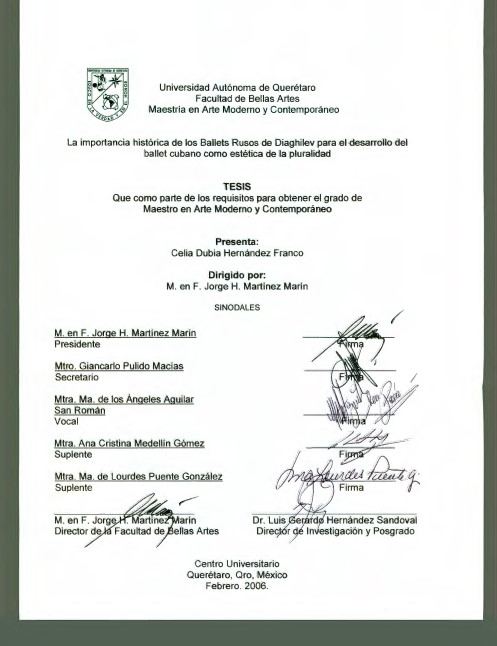
La importancia histórica de los Ballets Rusos de Diaghilev para el desarrollo del ballet cubano como estética de la pluralidad.
Dublin Core
Título
La importancia histórica de los Ballets Rusos de Diaghilev para el desarrollo del ballet cubano como estética de la pluralidad.
Autor
Celia Dubia Hernández Franco
Mediador
M. en F. Jorge H. Martínez Marín
Procedencia
Facultad de Bellas Artes/Maestría en Arte Moderno y Contemporáneo
Resumen
Este trabajo de tesis lleva por título "La importancia histórica de los Ballets Rusos de Diaghilev para el desarrollo del Ballet Cubano como estética de la pluralidad", y tiene como objetivo demostrar mediante una investigación histórico - descriptiva, la importancia de los Ballets Rusos de Diaghilev para la integración de distintos aspectos artísticos en el desarrollo de la Escuela Cubana de Ballet. En el Capítulo 1 se hace una descripción histórica general de los antecedentes del ballet, atendiendo en especial al Romanticismo. En el Capitulo 11 se expone una visión histórica particular, la de los Ballets Rusos de Diaghilev, la figura de éste, y la integración de Mijail Fokín por sus importantes aportes a la coreografía. En el Capítulo 111 se presenta una visión histórica en la que se integra la pluralidad para la concepción del arte del ballet. En especial, es en ese capítulo, en el que se trata sobre un concepto de integración de pluralidad que está relacionado con la participación de la plástica para la construcción de la imagen como elemento artístico relacionado con el ballet. En el Capítulo IV se expone una visión histórica de un hecho particular que tiene que ver con la conformación de la Escuela Cubana de Ballet. En ese capítulo se define, el concepto de escuela de ballet, la descripción de la formación histórica de la Escuela Rusa Antigua y la importancia que esta tuvo para el surgimiento de la Escuela Cubana de Ballet y sus características técnicas. En el último Capitulo, el V, se trata en específico de la influencia de los Ballets Rusos en la Escuela Cubana de Ballet, así como de Nijinski, como bailarín principal de esta compañía y de otras figuras importantes. En las conclusiones, se exponen las razones por las que se puede considerar que hay elementos artísticos, basados en la pluralidad de diferentes culturas para concebir el arte del ballet como un arte autónomo y universal.
Descripción
This thesis work is named "The Historical lmportance of Diaghilev Russian Ballets
for the Development of Cuban Ballet as aesthetic of plurality". lt's main goal is to
demonstrate through a historical and descriptive research the importance of
Diaghilev Russian Ballets for the integration of different artistic features in the
development of Cuban Ballet School. In Chapter 1 a general historical description,
of the background is made, paying special attention to Romanticism. In Chapter 11
is presented the particular historie vision of the Diaghilev Russian Ballet, its role as
well as the integration of Mijail Fokin for his important contributions to
choreography. In Chapter 111 is presented a historical vision in which is integrated
the plurality for the conception of Ballet Art. In this Chapter in particular is where
the work will deal with a concept of integration of plurality which is related to the
participation of the plastics arts for the construction of the image as an artistic
element related to ballet. In Chapter IV is presented a historical vision of a
particular fact which has to do with the conformation of the Cuban Ballet School. In
this Chapter the concept of Ballet School to defined, the description of the historical
formation of the Antique Russian School and the importance that it had for the
emergence of the Cuban Ballet School and it's technical caracteristics. In the last
Chapter the specific tapie is the influence of the Russian Ballet in the Cuban Ballet
School, as well as the influence of Nijinski as the main dancer of this company and
other important figures. In the conclusions is a presented the reasons why it can be
considered that there are artistic elements based on the plurality of the cultures to
conceive the Art of Ballet as an autonomus and universal art.
for the Development of Cuban Ballet as aesthetic of plurality". lt's main goal is to
demonstrate through a historical and descriptive research the importance of
Diaghilev Russian Ballets for the integration of different artistic features in the
development of Cuban Ballet School. In Chapter 1 a general historical description,
of the background is made, paying special attention to Romanticism. In Chapter 11
is presented the particular historie vision of the Diaghilev Russian Ballet, its role as
well as the integration of Mijail Fokin for his important contributions to
choreography. In Chapter 111 is presented a historical vision in which is integrated
the plurality for the conception of Ballet Art. In this Chapter in particular is where
the work will deal with a concept of integration of plurality which is related to the
participation of the plastics arts for the construction of the image as an artistic
element related to ballet. In Chapter IV is presented a historical vision of a
particular fact which has to do with the conformation of the Cuban Ballet School. In
this Chapter the concept of Ballet School to defined, the description of the historical
formation of the Antique Russian School and the importance that it had for the
emergence of the Cuban Ballet School and it's technical caracteristics. In the last
Chapter the specific tapie is the influence of the Russian Ballet in the Cuban Ballet
School, as well as the influence of Nijinski as the main dancer of this company and
other important figures. In the conclusions is a presented the reasons why it can be
considered that there are artistic elements based on the plurality of the cultures to
conceive the Art of Ballet as an autonomus and universal art.
Fecha de creación
2006
Identificador
ReDCAAcademico000025
Sumario
Académico/ReDCA/Facultad de Bellas Artes
Propietarios de los derechos
Académico, ReDCA, FBA, UAQ
Licencia
Creative Commons: Attribution-NonCommercial-NoDerivatives 4.0 International (CC BY-NC-ND 4.0) (https://creativecommons.org/licenses/by-nc-nd/4.0/)
Colección
Other Media
Citación
Celia Dubia Hernández Franco, “La importancia histórica de los Ballets Rusos de Diaghilev para el desarrollo del ballet cubano como estética de la pluralidad.,” ReDCA-Académico, consulta 3 de junio de 2026, http://redca.uaq.mx/academico/items/show/5.
Documentos relacionados
Este objeto no tiene relaciones.