
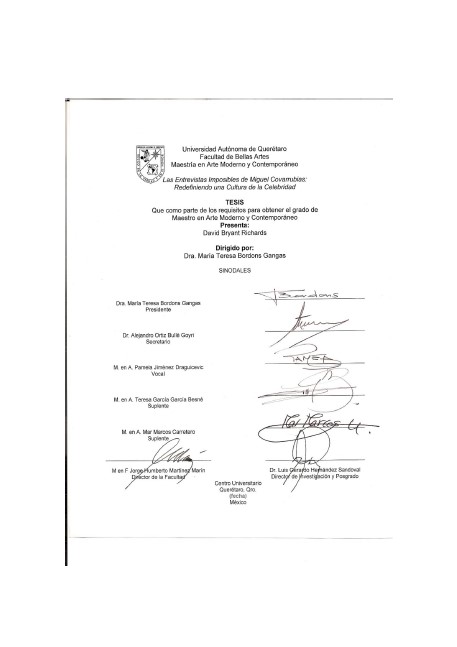
Las Entrevistas Imposibles de Miguel Covarrubias: Redefiniendo una Cultura de la celebridad.
Dublin Core
Título
Las Entrevistas Imposibles de Miguel Covarrubias: Redefiniendo una Cultura de la celebridad.
Autor
David Bryant Richards
Mediador
Dra. María Teresa Bordons Gangas
Procedencia
Facultad de Bellas Artes/Maestría en Arte Moderno y Contemporáneo
Resumen
El artista mexicano Miguel Covarrubias ya era famoso como caricaturista en Estados Unidos, cuando en 1931 empezó lo que serían las Entrevistas Imposibles, las caricaturas más astutas e innovadoras de su carrera. Hizo la serie de 38 guaches –más o menos uno cada mes- para la revista Vanity Fair y cuando esta publicación fracasó en 1935, siguió con su revista hermana Vogue. Las Entrevistas Imposibles no sólo representan el pináculo de su obra como caricaturista, sino también marcan un paso significativo en el desarrollo del mundo posmoderno. La tesis que propongo, “Las Entrevistas Imposibles de Miguel Covarrubias: Redefiniendo una cultura de la celebridad”, examina la importancia artística de esta serie en la obra de Covarrubias, y muestra cómo ella encarnaba nuevos conceptos de la fama, de la identidad y del éxito, y cómo contribuyó a la formación de lo que el filósofo francés Guy Debord llamó “la societé du spectacle”. Cada entrevista, que era acompañada por un diálogo satírico escrito por Corey Ford, representaba el encuentro entre dos personas muy conocidas por el público, pero que no se conocían entre sí, ni tenían nada en común aparte de la fama. (Así, por ejemplo, Jean Harlow, la estrella plateada de Hollywood y Sigmund Freud, el psicoanalista.) Porque Covarrubias hizo la mayoría de sus caricaturas en Estados Unidos para revistas neoyorkinas, gran parte de la documentación de su carrera como caricaturista se encuentra, sobre todo, en Washington, D.C. (The National Portrait Gallery, The Library of Congress), en Nueva York (The New York Public Library, The Library for the Performing Arts) y en Austin, Texas (The Harry Ransom Humanities Research Center). A partir de las Entrevistas Imposibles, la tesis explica los cambios culturales importantes que tuvieron lugar en Estados Unidos en los años 30. Al mismo tiempo, muestra cómo las entrevistas anuncian el siglo 21 y un sistema social que valoriza la celebridad, la máscara y el simulacro más que la realidad misma. Además la tesis se basa en observaciones de tales expertos en la caricatura como Beverly Cox, Wendy Rick Reaves, Sylvia Navarrete, Adriana Williams y Daniel Boorstin.
Descripción
The Mexican artist Miguel Covarrubias was already famous in the United States as a caricaturist, when in 1931 he began the series, “Impossible Interviews”, easily the most innovative caricatures of his career. All told, he produced 38 gouaches, roughly one per month, for the magazine Vanity Fair and then, when that publication folded in 1935, for its sister publication, Vogue. The Impossible Interviews not only represent the pinnacle of his caricatural work, but also mark a significant step in the development of the postmodern world. The thesis which I propose – “The Impossible Interviews of Miguel Covarrubias: Redefining a Culture of Celebrity,” examines the artistic importance of these works and shows how they incorporated new definitions of fame, identity and success, and contributed to the development of what French philosopher Guy Debord called “la societé du spectacle”. Each caricature, which was accompanied by an imaginary conversation written by Corey Ford, paired two celebrities, well known to the public, but who had never actually met in real life (for example, psychiatrist Sigmund Freud and screen star Jean Harlow). Since Covarrubias did the majority of his caricatures in the United States before returning to Mexico in the mid-1930s, much of the documentation for the thesis is to be found in The National Portrait Gallery and The Library of Congress (Washington, D.C.), The New York Public Library and the Library for the Performing Arts (New York) and The Harry Ransom Humanities Research Center (Austin, Texas). Using the Impossible Interviews, the thesis illuminates important cultural changes that took place in America in the 1930s. At the same time, it will show how they anticipate the 21st century and a social system which values fame, the mask, and the simulacrum more than reality itself. In addition, the thesis relies upon observations by Covarrubias’s contemporaries, as well as latter-day experts in caricature and celebrity, such as Beverly Cox, Wendy Rick Reaves Reaves, Sylvia Navarrete, Adriana Williams and Daniel Boorstin.
Identificador
ReDCAAcademico000032
Sumario
Académico/ReDCA/Facultad de Bellas Artes
Propietarios de los derechos
Académico, ReDCA, FBA, UAQ
Licencia
Creative Commons: Attribution-NonCommercial-NoDerivatives 4.0 International (CC BY-NC-ND 4.0) (https://creativecommons.org/licenses/by-nc-nd/4.0/)
Colección
Other Media
Citación
David Bryant Richards, “Las Entrevistas Imposibles de Miguel Covarrubias: Redefiniendo una Cultura de la celebridad.,” ReDCA-Académico, consulta 3 de junio de 2026, http://redca.uaq.mx/academico/items/show/34.
Documentos relacionados
Este objeto no tiene relaciones.